Lead placement deviations
Lead placement deviations
Sometimes it maybe necessary to place the electrodes in an alternative position to the standardised ones. Any deviations in electrode positions should be clearly marked on the ECG.

Pendulous breasts
In some individuals the breast size can make it difficult to determine and place the electrodes in the standard way. The options are to either place the electrodes underneath or above the breast tissue. The Society for Cardiological Science & Technology (2006) guidelines advise that the electrodes be placed under the breast tissue but some authorities state that it makes little difference. However for the purposes of consistency, electrode position should be documented on the top of the ECG.
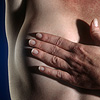
Mastectomy
Standard electrode postion should be used on patients who have undergone a mastectomy. If scarring causes any problems with electrode adhesion or locating landmarks it should be documented.
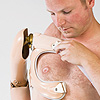
Amputation
If the patient has undergone an amputation of one or more limbs, the ECG can still be performed with the electrodes being placed either on stump or the torso depending on the extent of the amputation. The adapted electrode position must be clearly marked on the ECG.
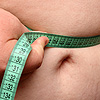
Obesity
Obesity can cause difficulty in locating the standardised landmarks. You will need to place electrodes as close to the standardised positions as you can identify.
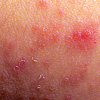
Dermatological issues
Patients with skin conditions such as psoriasis, eczema, long-term steroid use and other rashes may use medical moisturisers which can make electrode adhesion difficult. It is particularly important in these patients that the skin is prepared adequately. In patients with dermatological issues, extra care must be taken when applying and removing the electrodes.
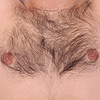
Hairy Chest
If the patient requires shaving in order to obtain good electrode contact then a single use safety razor should be utilised. Care should be taken not to cut the skin. The razor must be disposed of into a sharps bin after use.
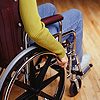
Positioning (scoliosis, wheelchair)
In patients who are unable to lie on the bed due to arthritis, scoliosis, or other health problems it may be necessary to obtain an ECG with them in a sitting position (on the bed or in a chair). This is acceptable but must be clearly documented on the ECG.
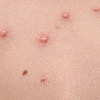
Infectious Diseases
Universal precaution should be utilised when performing all ECGs. If a patient is known to have an infectious disease it is essential that the machine and all accessories are thoroughly cleaned between uses.